What Real-World Shooting Data Reveals About Defensive Gun Use
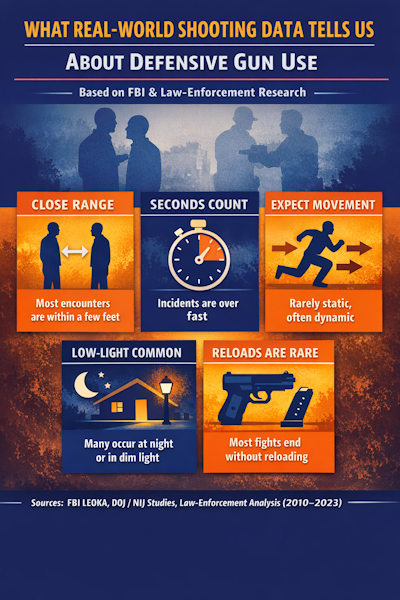 What Real-World Shooting Data Really Tells Us About Defensive Gun Use
Based on FBI and law-enforcement research, “real-world shooting data” (with clear limits on what the FBI does and does not track).
When people imagine a defensive gun use, they often picture a dramatic exchange: extended distances, perfect sight pictures,
multiple reloads, and plenty of time to think. That picture comes from movies, competition shooting, and outdated training models—
not from real-world shooting data.
Here’s the honest truth: there is no national FBI database that fully tracks civilian concealed-carry shootings
with detailed measurements like exact distance, time-to-stop, rounds fired, or reload counts. However, decades of
law-enforcement research—including FBI reporting and U.S. Department of Justice research—do show reliable
patterns about how violent encounters unfold. Those patterns matter to armed citizens because the human factors of violence
(speed, distance, stress, and decision-making) don’t magically change based on whether someone has a badge.
Where the Data Comes From (and Where It Doesn’t)
The FBI does not publish a report titled “How Gunfights Happen.” Instead, instructors and researchers commonly draw from:
- FBI LEOKA (Law Enforcement Officers Killed and Assaulted) annual reports
- FBI Use of Force Data Collection (agency-submitted use-of-force reporting)
- U.S. Department of Justice / National Institute of Justice (NIJ) research summaries
- Large-agency shooting analyses and peer-reviewed human performance studies
These sources focus on law enforcement rather than civilians. Still, they provide the best publicly available window into
how real violence plays out—without the fantasy.
What the Patterns Consistently Show
1) Distance Is Usually Very Close
LEOKA reporting and officer after-action summaries repeatedly show that many deadly encounters begin at
conversational or arm’s-length distance. For the armed citizen, that means defensive incidents are rarely
long-range marksmanship problems. They are often sudden, close, and fast.
2) Time Is Extremely Limited
Many violent encounters are decided in seconds, not minutes. Once violence begins, there is rarely time for
step-by-step problem-solving. This is why preparation matters: skills that only work under ideal conditions can fail under real stress.
3) Movement Is the Norm
In real encounters, people move. Attackers advance, retreat, sidestep, or flee. Defenders move to create distance, escape, or find cover.
Static square-range shooting does not reflect this reality. Training that ignores movement leaves students underprepared.
4) Low-Light Conditions Are Common
FBI LEOKA reports show a significant portion of violent encounters occur during nighttime or reduced-light conditions.
Low light complicates target identification, decision-making, and accuracy—factors that should be addressed in realistic training.
5) Reloads Are Rare in Defensive Encounters
Reviews of civilian defensive incidents and many law-enforcement encounters indicate that most outcomes occur
before a reload becomes relevant. This does not mean reload skills are unimportant. It means most fights are decided early.
What This Means for Responsible Training
Real-world patterns challenge outdated assumptions. Responsible training should emphasize:
- Close-range threat management and safe gun handling
- Decision-making under stress
- Movement and positional awareness
- Low-light considerations and identification
- Legal and moral restraint—not just mechanics
Owning a firearm does not automatically make someone safer. Thinking clearly, training honestly, and understanding reality does.
References (by Year)
- FBI — Law Enforcement Officers Killed and Assaulted (LEOKA), annual reports, 2010–2023.
- FBI — Use of Force Data Collection, published datasets/summaries, 2019–2023.
- National Institute of Justice (NIJ) research summaries on officer-involved shootings and use-of-force topics,
2014–2020. - NYPD SOP-9 Firearms Discharge Reports (historical trend analysis), 1970–1992.
- Force Science Institute research and publications on human performance under stress, 2006–2022.
- The Armed Citizen® (NRA Publications) civilian defensive gun use case reviews (trend review only),
2015–2024.
Important: These sources describe patterns and trends. They do not predict exactly what will happen in any single incident.
Training must always be paired with sound judgment and compliance with local laws.