
Why “Muzzle Down” Is Not Always Safe in Urban Environments
Why I No Longer Teach “Muzzle Down” as the Automatic Safe Direction
For years, most shooters were taught that “down” is the safest place to point a firearm.
I taught it too. It was tradition. It sounded simple. And in certain environments, it works.
But after years of training students, analyzing negligent discharges, and teaching in tight
indoor and urban environments, I’ve changed my position: “muzzle down is not always safe”
Down is not always safe — especially in urban environments.
A safe direction isn’t a slogan. It’s not automatic. It’s a decision based on reality.
If a gun fires unexpectedly, the only thing that matters is where that bullet goes.
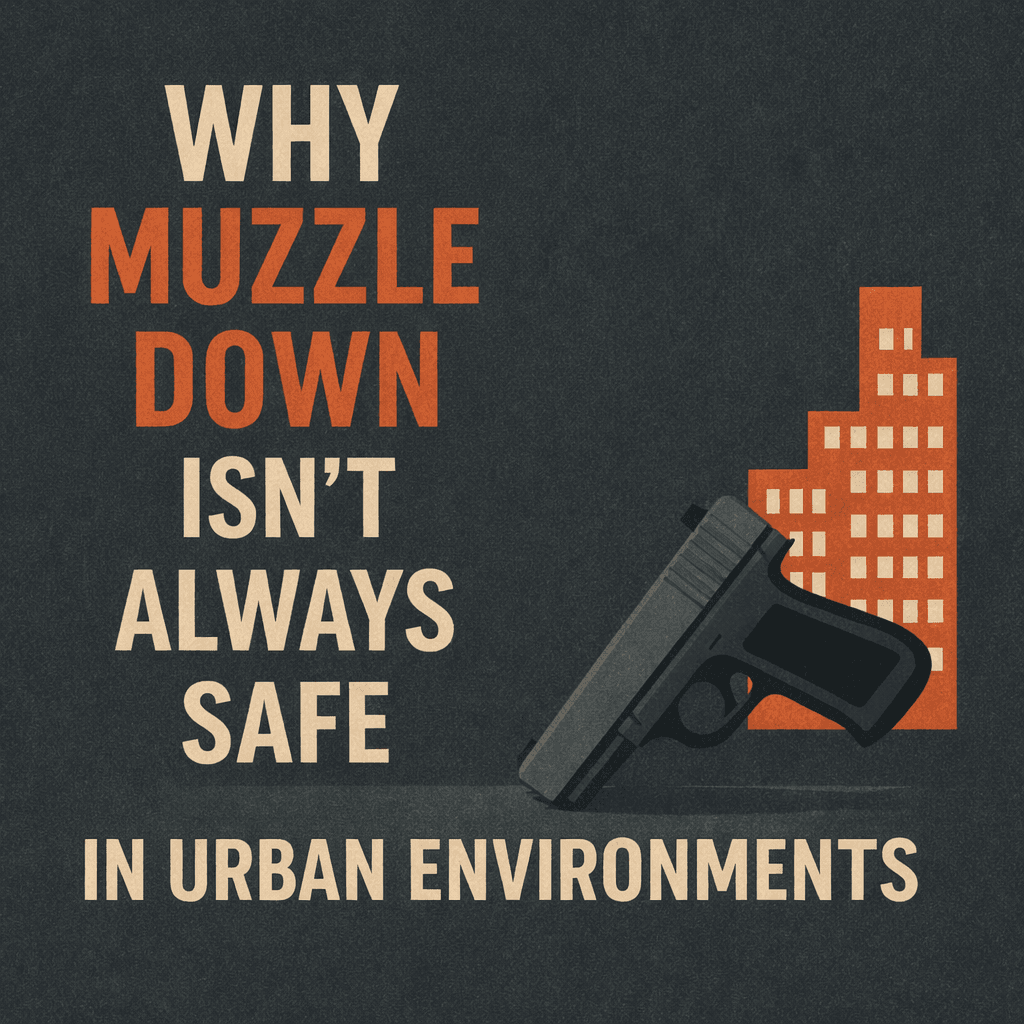
The Urban Problem: Floors Don’t Stop Bullets
In the real world, pointing the muzzle down can still send a bullet into people.
Concrete, tile, packed dirt, and flooring systems don’t reliably stop handgun rounds.
And worse, hard surfaces can turn bullets into unpredictable ricochets.
- Concrete sidewalks and parking lots cause ricochets.
- Handgun rounds can pass through floors into occupied rooms below.
- Basements and multi-level homes often have people underneath you.
- Even soil can deflect rounds if rocks are present.
In cities and suburbs, people live above you, below you, and beside you.
“Down” doesn’t mean “safe.” Sometimes it means “into someone else’s apartment.”
“Muzzle Up” Isn’t Automatically Safe Either
Some people respond by saying, “Fine, just point it up.” But that creates its own risks.
- Stray rounds don’t disappear — they come down somewhere.
- Indoors, you may have family or neighbors above you.
- Outside, you don’t control what’s overhead.
The point isn’t that up is bad. The point is that there is no universal safe direction.
The Safer Rule I Teach Now
I no longer teach students to default to “muzzle down.”
I teach this instead:
“Point the muzzle toward a location where it is acceptable to launch a bullet.”
That means you evaluate your environment before you handle a firearm. Every time.
Ask yourself:
- If this gun fired right now, where would the bullet land?
- Is anyone in that path — even behind walls or floors?
- Is the surface likely to cause a ricochet?
- Is there a direction with a reliable backstop or empty space?
The correct safe direction changes depending on where you are. That’s reality.
Examples of Safe Direction by Environment
Indoor range
Downrange. Always. That’s your engineered backstop.
Urban home
Floors may be unsafe. Ceilings may be unsafe. A structural wall with no one behind it might be safest.
The answer depends on who is around you and what your home is built like.
Crowded public setting (classroom, store, training room)
Blindly pointing down can be dangerous. A safer angle may be toward an exterior wall or
another known safe backstop — not tradition.
Vehicle environment
“Down” inside a vehicle can skip rounds off asphalt or send them through the floor into traffic.
The safe direction is the one that avoids people and avoids ricochet surfaces.
Why This Matters to Concealed Carry Students
Concealed carry isn’t range shooting. It’s life in the real world.
Real-world gun handling requires thinking, not scripts.
When students only memorize “muzzle down,” they stop thinking.
When you teach environmental safe direction, they stay aware in every setting.
Final Thought
I changed how I teach because reality forced me to.
Safety is not a posture. It’s a mindset.
Your muzzle belongs where it can do the least harm if the gun fires — not just where tradition says to put it.
Train With Me
If you want practical, real-world firearms training that goes beyond slogans and teaches
you how to think like a safe and prepared armed citizen, I can help.
Have Gun Will Train Colorado
Rick Sindeband
Pueblo, Colorado
Phone: 719-821-3958
Email: rick@havegunwilltraincolorado.com