Practice vs Training Firearms | Avoid Dangerous Bad Habits | Pueblo CO
Practice vs Training Firearms: Why Most Gun Owners Get It Backwards
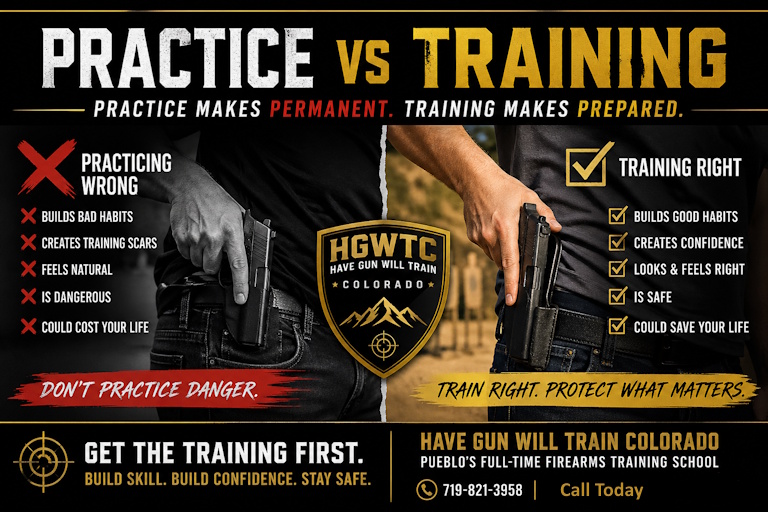
Practice is not the same as training.
I was listening to Tom Gresham on Gun Talk Radio the other day, and it reminded me of something I see all the time with students:
People practice—over and over—but they’re practicing the wrong things.
And that’s how bad habits get burned in.
Practice Makes Permanent — Not Perfect
If your technique is wrong, practice doesn’t fix it.
It locks it in.
What Happens When You Practice Without Training
Practice vs Training Firearms
In the firearms world, we call these mistakes training scars.
They’re habits that feel natural—because you’ve done them a thousand times—but they’re wrong, unsafe, or legally dangerous.
Common examples I see:
- Believing “down is always safe” (it isn’t)
- Thinking you need a thumb safety instead of proper handling
- Improper trigger finger placement during manipulation
- Sloppy loading and unloading procedures
- Unsafe or inconsistent draw strokes
None of those start as bad intentions.
They start as untrained practice.
Training Builds the Blueprint — Practice Reinforces It
Training is where you learn the correct method.
Practice is where you reinforce it.
If you skip the training step, you’re guessing.
And guessing with a firearm is a bad plan.
Drawing From the Holster: Where Things Go Wrong Fast
One of the biggest problem areas is the draw from a concealed holster.
It’s also one of the most dangerous things you can do with a handgun.
There’s a reason many ranges restrict or prohibit drawing from the holster:
- People muzzle themselves
- People sweep others
- People get on the trigger too early
- People rush the process
That’s not theory—that’s reality.
Now think about this:
If you practice the draw incorrectly…
You are literally training yourself to do something dangerous—faster.
5 Minutes a Day Done Right Beats 1,000 Reps Done Wrong
A short, structured training routine builds skill.
Unstructured repetition builds problems.
What Proper Practice Should Look Like
Once you’ve been trained correctly, your practice should be:
- Slow and deliberate
- Focused on safety first
- Based on a proven process
- Consistent every time
- Built on correct fundamentals
Even 5 minutes a day of correct practice can dramatically improve your skills.
But only if the foundation is solid.
Get the Training First
Don’t build bad habits you’ll have to unlearn later.
Get professional, in-person firearms training that shows you how to do it right the first time.
Have Gun Will Train Colorado
Pueblo’s Full-Time Firearms Training School
719-821-3958
View Class Schedule
Recommended Training
- Handgun Fundamentals Training
- Colorado Concealed Carry Permit Class
- Concealed Carry Renewal / Refresher
Serving Pueblo, Canon City, Florence, Penrose, Westcliffe, Colorado Springs, and all of Southern Colorado.