Reasonable Handgun Proficiency: How Good Should You Be?
Reasonable Handgun Proficiency: How Good Do You Really Need to Be?
One of the problems in the firearms-training world is that we sometimes make shooting more complicated than it needs to be.
Can you safely and reliably perform the basic skills you may actually need?
Watch enough videos or spend enough time around serious shooters and you may come away believing that being proficient with a handgun means shooting tiny groups at long distances, drawing in fractions of a second, performing complicated drills or shooting at competition speed.
Those are worthwhile skills for someone who wants to develop them.
But is that really where handgun proficiency begins?
I don’t think so.
For the ordinary gun owner—and particularly someone who carries a handgun for personal protection—I believe we should start with a much simpler question:
That is reasonable proficiency.
Proficiency Starts With Safety
Before worrying about speed, shot timers, or advanced shooting drills, you need to be able to safely operate your handgun.
Can you:
- Load it correctly?
- Unload it correctly?
- Visually and physically verify that it is unloaded?
- Lock the slide open?
- Operate the controls without confusion?
- Keep your finger away from the trigger when you aren’t shooting?
- Keep the muzzle pointed in a safe direction?
- Safely holster and unholster the handgun?
Those aren’t beginner skills that you eventually leave behind.
They are handgun skills.
The better you become, the more consistently you perform those basic skills.
How Good Does Your Shooting Need to Be?
Claude Werner, known as The Tactical Professor, recently wrote about what he calls
reasonable proficiency.
His point is worth considering.
Firearms instructors can unintentionally create standards that intimidate beginning and occasional shooters. A person doesn’t have to become a competitive shooter or devote his life to firearms training to develop useful handgun skills.
At the same time, merely owning a handgun doesn’t make someone proficient with it.
There is a reasonable place between those two extremes.
A handgun owner should be able to safely operate the firearm and consistently make useful hits at reasonable handgun distances.
That’s measurable.
A Simple Practice Session
Here’s a simple practice session that I like because it doesn’t require complicated equipment or advanced techniques.
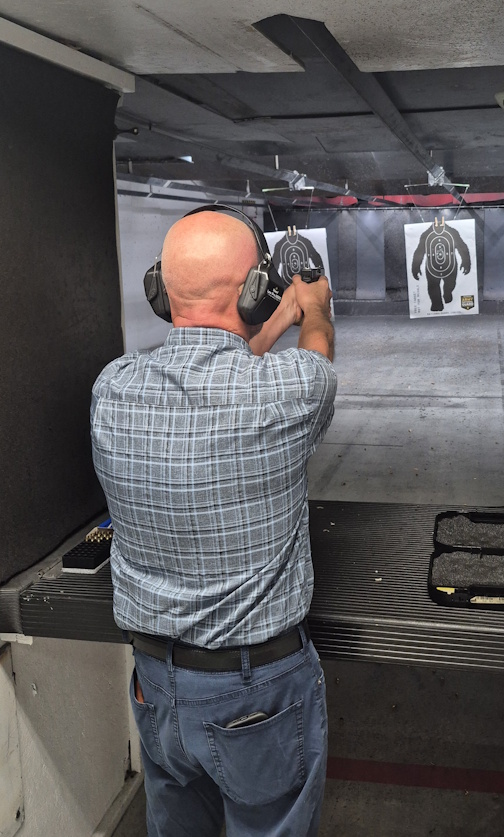
The 3-5-7 drill is a simple distance-based practice exercise commonly used in defensive handgun training. It uses a full-size silhouette-type target and has the shooter fire:
5 yards — 12 rounds
7 yards — 12 rounds30 rounds total
Don’t initially worry about doing it quickly.
Concentrate on safe gun handling, sight alignment, trigger control and making good hits.
If you can’t consistently keep your shots where they need to be at those distances, you’ve identified something that needs work.
That’s exactly what practice is supposed to accomplish.
Once you can make those hits consistently, you can gradually introduce reasonable time pressure.
Accuracy comes first.
The First Hit Matters More Than the First Shot
This brings us to another important distinction.
Being the first person to fire isn’t the goal.
Making an effective hit is.
An NRA Shooting Illustrated article examining
competency standards for concealed carry
makes the point that analysis of defensive shootings strongly suggests that the person who first delivers an accurate, solid hit gains an important advantage.
That’s an important distinction.
A fast miss doesn’t solve your problem.
Worse, every bullet you fire is going somewhere.
For the armed citizen, accuracy isn’t merely a shooting score. There may be innocent people beyond or around the threat.
That doesn’t mean speed is irrelevant.
It means we should develop accuracy first and then learn to deliver that accuracy with appropriate speed.
But Your Most Important Skill May Happen Before the Gun Comes Out
This is where handgun proficiency becomes something larger than marksmanship.
I have talked about
transitional spaces
in my classes for years. I also wrote about them back in 2017.
A transitional space is simply an area we pass through while moving from one place to another.
Think about:
- Parking lots
- Parking garages
- Gas stations
- Doorways
- Building entrances and exits
- Corners
- ATMs
- Walking to or from your vehicle
- Getting into or out of your vehicle
These places deserve additional attention because we’re often distracted while moving through them.
We’re looking for our keys or carrying groceries. We’re putting something into the car. We’re checking our phone. We’re opening or closing a door.
Our attention is divided.
Awareness Can Buy You Something More Valuable Than Speed
Suppose you’re walking across a parking lot toward your vehicle.
Which would you rather have?
The ability to recognize a developing problem early enough to change direction, return to the store, get into your vehicle, create distance or otherwise avoid the encounter?
Or the ability to draw a handgun extremely quickly after you’ve already allowed the problem to get close to you?
That’s why defensive handgun proficiency can’t be measured entirely by what happens on a shooting range.
The shooting range measures shooting.
It doesn’t necessarily measure awareness, judgment, avoidance, or decision-making.
Those skills matter too.
Concealed Carry Is a Mission
I’ve said this to students many times:
It isn’t simply putting a handgun under your shirt and going about your day.
If you’ve decided to carry a firearm for personal protection, you’ve accepted additional responsibilities.
Understand your firearm.
Understand the laws governing its use.
Use appropriate equipment, including a proper belt and holster.
Pay attention to what’s happening around you.
Maintain reasonable proficiency with your handgun.
That doesn’t mean you need to live at the shooting range.
It does mean you should be honest with yourself about your abilities.
Practice Doesn’t Have to Be Complicated
Thirty deliberate rounds can tell you quite a bit.
Can you safely manipulate the handgun?
Can you consistently make good hits at 3 yards?
At 5 yards?
At 7 yards?
If you can, start working on doing the same thing a little more efficiently.
If you can’t, slow down and work on the fundamentals.
Don’t turn every range session into an ammunition-burning contest.
Have a purpose.
Twenty-five or thirty carefully fired rounds while concentrating on a specific skill can sometimes accomplish more than firing 200 rounds without a plan.
And remember that much of your gun handling can be practiced without firing ammunition at all, provided dry practice is conducted safely.
Reasonable Proficiency Is a Beginning, Not an Ending
None of this means you should stop improving once you can consistently hit a target at seven yards.
There is always another skill to learn.
- Shoot farther.
- Learn to draw safely from your concealed-carry holster.
- Work with your support hand.
- Practice reloads.
- Learn to clear common malfunctions.
- Improve your accuracy.
- Improve your speed.
But don’t confuse advanced performance with the minimum level of competence every handgun owner should be working toward.
Start with safe gun handling.
Learn to operate your handgun without confusion.
Learn to make consistent hits at reasonable distances.
Practice enough that those fundamental skills don’t disappear between trips to the range.
And perhaps most importantly, develop the awareness and judgment that may allow you to recognize trouble before shooting becomes necessary.
You don’t have to be an expert to be competent.
But owning a handgun doesn’t make you competent either.
Reasonable handgun proficiency lives somewhere between those two points—and regular, purposeful practice is how you get there.