Firearms Incidents Are Not Accidents | Negligence, Safety & Training
Stop Calling It an Accident
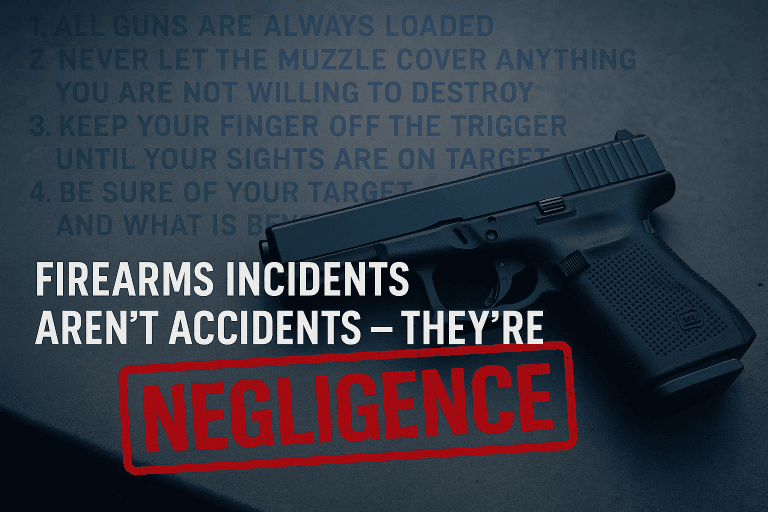
Most firearms incidents are not accidents. They are usually the result of poor handling, broken safety rules, bad habits, or a lack of proper training.
Firearms safety is not complicated, but it does require discipline. When someone has an unintended discharge, points a firearm in an unsafe direction, leaves a gun unsecured, or places a finger on the trigger at the wrong time, calling it an “accident” often hides the real problem.
The better word is negligence.
Accident vs. Negligence
An accident is something that could not reasonably be prevented. True mechanical failure or a completely unforeseeable event may fall into that category.
Negligence is different. Negligence means someone failed to follow basic safety rules, ignored proper procedures, or handled a firearm carelessly.
That distinction matters because firearms are deadly tools. The language we use affects how seriously people take responsibility.
The Four Firearms Safety Rules Matter
Responsible gun owners should know and follow the basic safety rules every time they handle a firearm.
- All guns are always loaded.
- Never let the muzzle cover anything you are not willing to destroy.
- Keep your finger off the trigger until your sights are on target.
- Be sure of your target and what is beyond it.
If these rules were followed consistently, most so-called accidental shootings would never happen. When a person violates one or more of these rules, the result is usually not bad luck. It is bad gun handling.
Why the Word “Accident” Causes Problems
Calling every unintended discharge an accident removes responsibility. It makes the event sound like fate, chance, or bad luck.
But guns do not simply “go off” by themselves under normal handling. Someone loaded the firearm, pointed the firearm, and touched the trigger. Someone failed to verify the condition of the firearm.
That is why language matters.
When we call negligent behavior an accident, we lower the standard. When we call it negligence, we put responsibility where it belongs.
Common Examples of Negligent Firearms Handling
- Pointing the muzzle at people while removing a firearm from a case or holster
- Putting a finger on the trigger before the gun is on target
- Failing to remove the magazine before clearing a semi-auto pistol
- Failing to lock the slide open and visually inspect the chamber
- Handling firearms casually at home, in vehicles, or on the range
- Leaving loaded firearms accessible to children or unauthorized persons
- Assuming a firearm is unloaded without checking it properly
Training Fixes Bad Habits
Most people do not need fancy shooting tricks. They need solid fundamentals, safe handling habits, and someone willing to correct unsafe behavior before it becomes dangerous. Firearms incidents are not accidents.
At Have Gun Will Train Colorado, we focus heavily on safe gun handling, loading and unloading procedures, muzzle discipline, trigger finger discipline, and responsible firearm ownership.
Responsible Gun Owners Must Raise the Standard
Gun owners, concealed carry permit holders, instructors, and range officers should not excuse careless gun handling. We should correct it.
That does not mean embarrassing people. It means being honest. If someone does something unsafe, it needs to be addressed immediately.
Firearms safety is not about ego. It is about preventing tragedy.
Final Thoughts
If you own, carry, or handle a firearm, the responsibility is yours. You are responsible for the muzzle, and you are responsible for the trigger. Also you are responsible for the condition of the firearm.
Stop calling preventable firearms incidents accidents.
Call them what they are: negligence.
Related Training
Popular Training Courses
Why Train with Have Gun Will Train Colorado?
Have Gun Will Train Colorado is Southern Colorado’s full-time firearms training school. Since 2010, Rick Sindeband has trained thousands of students in concealed carry, firearm safety, handgun fundamentals, and defensive firearms skills.
Our goal is simple: help responsible gun owners build safe habits, develop practical skills, and understand the legal responsibilities that come with firearm ownership.
Firearms Safety Resources
- Jeff Cooper — background on the instructor often associated with the modern Four Rules of firearm safety.
- Project ChildSafe — firearm safety and secure storage information.
- NRA Gun Safety Rules — basic gun safety rules for responsible firearm handling.
Get Trained the Right Way
Whether you are a new gun owner, a concealed carry permit holder, or simply want to improve your firearms handling skills, proper training matters.