Draw From the Holster Training in Pueblo, Colorado | HGWTC
Have Gun Will Train Colorado
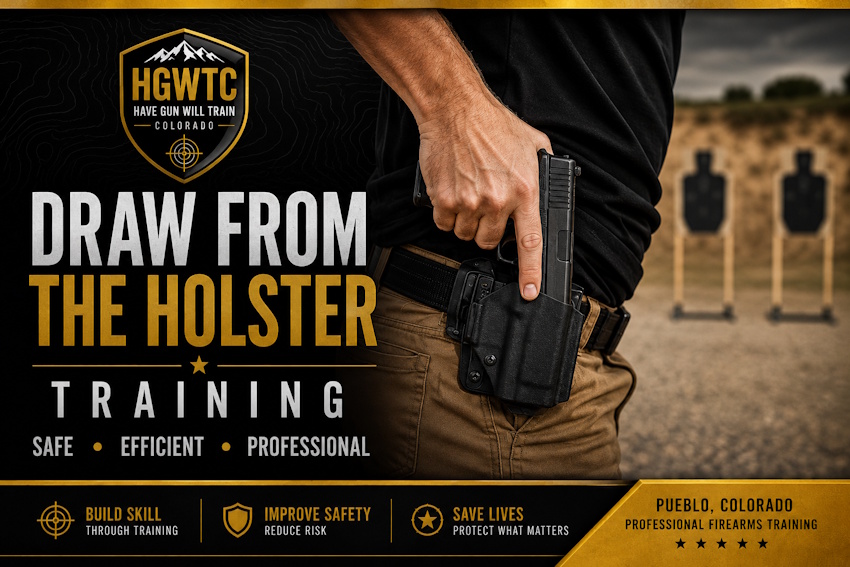
Draw From the Holster Training in Pueblo, Colorado
A safe draw stroke is not about being the fastest person on the range. It is about controlling the handgun, protecting the trigger and making the right decision before the gun ever leaves the holster.
Most concealed carry permit holders never receive formal instruction on drawing a handgun from a holster. They purchase a handgun, buy a holster, watch a few videos and begin practicing on their own.
Unfortunately, that is also how unsafe habits become established. Drawing from the holster involves much more than pulling the handgun out quickly. It requires suitable equipment, a complete firing grip, muzzle control, trigger-finger discipline, a repeatable presentation and the judgment to know whether the handgun should leave the holster at all.
Speed is not the starting point.
Safety, consistency and correct movement come first. Speed develops only after the movement is performed correctly.
Why Holster Training Matters
A concealed handgun may spend hundreds or thousands of hours inside its holster. Yet many gun owners receive little or no supervised instruction on safely presenting that handgun.
Every draw stroke places the muzzle close to parts of your own body. A poor grip, a finger entering the trigger guard too early, an obstructed holster or a rushed reholster can produce permanent consequences.
Professional instruction allows an experienced instructor to watch the entire movement. Problems can be corrected before unsafe or inefficient habits become automatic.
Students who still need work on basic handling should begin with Primary Handgun Skills training . Safe loading, unloading, clearing, grip, muzzle discipline and trigger-finger discipline should already be consistent before beginning live-fire holster work.
Proper Holster Equipment Comes First
One of the most common problems I see in firearms classes is inappropriate equipment. A holster may be comfortable, inexpensive or easy to conceal and still be a poor choice for defensive carry or live-fire training.
A suitable concealed carry holster should:
A holster is safety equipment.
Soft holsters that collapse, poorly fitted universal holsters and holsters that leave the trigger exposed should not be used for live-fire draw practice. Nothing should be able to enter the trigger guard while the handgun is carried or reholstered.
Safariland publishes guidance concerning holster fit, retention and safe use. You can review its holster safety warnings and its explanation of holster retention systems .
Also read our article about small concealed carry guns and small holsters . Smaller equipment does not automatically mean safer, easier or more effective equipment.
A Basic Pistol Class Does Not Teach Every Skill
Basic pistol instruction normally concentrates on firearm safety, handgun operation, ammunition, grip, sight alignment, trigger control, marksmanship and range procedures.
Those subjects are important, but they do not automatically prepare a student to safely draw a loaded handgun from concealment. Drawing from the holster is a separate skill requiring additional knowledge, suitable equipment, an appropriate range and close supervision.
The NRA Personal Protection Outside the Home Instructor course is one instructor-level program that specifically addresses defensive handgun skills outside the home.
Karl Rehn of KR Training has written extensively about the difference between minimum-level permit training and the additional work required to develop practical defensive handgun skills. The point is not that only one organization can teach a draw stroke. The point is that a basic handgun certification does not automatically qualify someone to teach every advanced defensive technique.
The Parts of a Safe Draw Stroke
Some instructors teach a four-step draw. Others describe five positions. The exact number of named steps matters less than whether every movement is safe, repeatable and efficient.
Recognize
Identify the problem and decide whether drawing is necessary and legally justified.
Grip
Clear the cover garment and establish a complete firing grip before the handgun moves.
Clear
Remove the handgun without allowing the muzzle to cover your body or support hand.
Present
Join the support hand safely and present toward the target while keeping the finger indexed.
Slow and Correct Comes Before Fast
New students often want to measure success with a shot timer. A timer can eventually become a useful training tool, but it should never be used to rush an unsafe or inconsistent movement.
We begin slowly. The student establishes the proper grip, clears the holster, moves through a consistent index position and presents the handgun without allowing the muzzle to cross the body.
Each repetition should look much like the one before it. Smooth movement removes unnecessary motion. With correct practice, smooth movement gradually becomes more efficient.
The Ready Position Is Part of the Draw Stroke
The handgun does not always need to be driven immediately to full extension. A controlled ready or indexed position may be useful when the situation is still developing, when the threat is close or when the shooter must continue evaluating what is happening.
That position must still protect the trigger, control the muzzle and prevent the shooter from sweeping the support hand or other parts of the body.
Students also need to understand that the gun is not a communication device. It should not be drawn merely to frighten, warn or control another person.
A concealed carry permit does not make you a police officer and does not give you special authority over other people. The handgun is a last-resort defensive tool—not a shortcut for winning an argument or forcing someone to comply.
There Is No Prize for Fast Reholstering
The emergency that caused the handgun to be drawn should be over before the handgun is returned to the holster.
Reholstering should be slow, deliberate and visually verified. Clothing, drawstrings, straps, fingers and other objects must be kept away from the trigger and trigger guard.
The shooter should confirm that the holster opening is clear before inserting the handgun.
Draw only as fast as you can safely control.
Reholster more slowly than you drew.
Holster Practice Requires the Right Range
Many public and commercial shooting ranges prohibit drawing from the holster. Others allow it only during supervised training or after the shooter has completed an approval process.
A concealed carry permit does not override range rules. Never assume holster practice is permitted simply because you are legally carrying a handgun.
We are fortunate to have access to a Pueblo-area range that permits approved holster work under established rules. Students use a suitable strong-side belt holster. Other carry methods may require separate authorization and direct instructor supervision.
Knowing When Not to Draw Is Part of the Skill
A technically perfect draw can still produce a disastrous outcome when an armed citizen misunderstands what is happening.
Before touching the handgun, identify the threat, determine who is involved and decide whether you or another person is facing an imminent threat of death or serious bodily injury.
What don’t you know yet?
The first person you see holding a gun is not automatically the criminal. You may have entered the situation after it started.
This is the connection between physical handgun skills and the decision-making principles discussed in our mistaken-identity project. The ability to draw quickly is useless when you have not correctly identified the threat.
Do not become involved merely because you are armed. Your concealed handgun is there to protect you and the people you must protect when there is no reasonable option left. That is the difference between pulling a handgun because you want to and drawing because you truly have to.
Experienced Firearms Instruction in Pueblo
I have taught firearms skills in Southern Colorado since 2010 and hold NRA instructor certifications in Pistol, Rifle, Shotgun, Personal Protection Inside the Home, Personal Protection Outside the Home and Metallic Cartridge Reloading.
One of my mentors, Patrick Watts, a law enforcement firearms instructor, spent many hours helping me refine the draw-from-the-holster techniques I continue to teach today.
Students receive direct observation and individual correction. We identify unsafe movement, equipment problems and inefficient habits before those habits become deeply established.
Students who already have experience can work on improving their presentation, clearing a cover garment and building a smoother, safer draw. Newer students may need Primary Handgun Skills before advancing to live-fire holster work.
Get Professional Holster Training
Learn how to safely draw, present and reholster your handgun under the supervision of an experienced Pueblo firearms instructor.
Learn About Holster Training View the Training ScheduleContinue Building Your Handgun Skills
Primary Handgun Skills
Improve loading, unloading, grip, muzzle control, trigger discipline and safe handgun handling.
Read More →Small Guns and Small Holsters
Understand the equipment problems associated with very small handguns and poorly selected holsters.
Read More →Develop Better Shooting Skills
Learn why correct practice and useful feedback matter more than simply firing more ammunition.
Read More →Self-Defense Priorities
Put awareness, avoidance, movement and sound judgment ahead of reaching for the handgun.
Read More →Vehicle Firearm Tactics
Consider access, movement, muzzle control and decision-making around a vehicle.
Read More →Handling Your Carry Firearm
Reduce unnecessary administrative handling and the risks created by repeated loading and unloading.
Read More →Draw From the Holster Frequently Asked Questions
Do Colorado concealed carry classes teach drawing from a holster?
Not necessarily. Colorado concealed handgun permit training covers required safety, legal and live-fire subjects, but that does not mean every class includes live-fire holster instruction. Holster work is a separate skill requiring suitable equipment, an appropriate range and close supervision.
What kind of holster do I need for training?
The holster must completely protect the trigger guard, retain the handgun, remain firmly attached to the belt and hold its shape when the handgun is removed. A suitable strong-side belt holster is generally required for our range work.
Can I learn to draw from a holster by watching videos?
A video may demonstrate a technique, but it cannot see your muzzle direction, grip, trigger-finger placement or equipment problems. Supervised instruction provides immediate feedback before unsafe habits become established.
Should I practice drawing with a loaded handgun at home?
Live ammunition should not be present during dry-practice sessions. The handgun must be unloaded and verified, and the practice area must provide a safe direction and suitable backstop. New shooters should receive professional instruction before beginning unsupervised holster practice.
How fast should I be able to draw?
There is no single draw time proving someone is prepared for every defensive situation. Begin with a safe, consistent and accurate presentation. Measure speed only after the movement can be performed correctly.
Is reholstering included in the training?
Yes. Safe reholstering is an essential part of holster training. Students learn to slow down, confirm that clothing and other objects are clear, maintain trigger-finger discipline and return the handgun to the holster deliberately.
Train Safely. Build the Skill Correctly.
Contact Have Gun Will Train Colorado to arrange draw-from-the-holster instruction or begin with Primary Handgun Skills.
Draw From the Holster Training Primary Handgun Skills