Your Carry Gun Isn’t the Gun You Should Learn On | HGWTC
Your Carry Gun Isn’t the Gun You Should Learn On
Why the handgun that’s easiest to carry isn’t always the handgun that’s easiest to learn to shoot.
I see this regularly in firearms classes.
A new shooter shows up with a small handgun they purchased specifically for concealed carry. It’s compact, lightweight and easy to conceal. Someone may have recommended it because it’s a popular carry gun, or the shooter may simply have picked it because it felt good in their hand at the gun store.
There may be absolutely nothing wrong with the handgun.
The problem is that the student is trying to learn basic handgun skills with one of the least forgiving types of handguns to learn on.
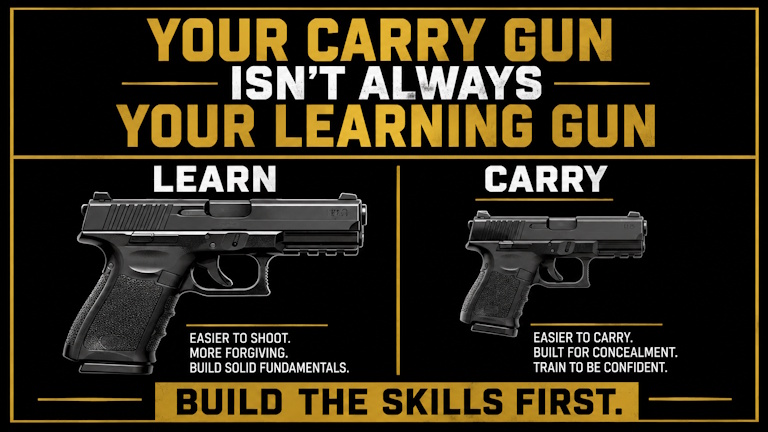
Your carry gun may eventually be the handgun you need to shoot best. That doesn’t necessarily mean it’s the handgun you should learn to shoot on.
We Usually Buy the Carry Gun First
For many new concealed carriers, the process goes something like this:
They decide they want to carry a handgun. Then they buy a handgun. Then they sign up for a concealed carry class. Somewhere along the way, they begin learning how to actually operate and shoot it.
From a training standpoint, we’ve put the equipment decision ahead of the skill development.
And because the purpose of the handgun is concealed carry, concealability often becomes one of the biggest considerations when choosing it.
Smaller. Lighter. Thinner.
Those are excellent qualities when you’re trying to conceal a handgun for ten or twelve hours.
They aren’t necessarily the qualities that make a handgun easier to learn to shoot.
The Gun Store Counter Test
There is a big difference between handling a handgun at a gun store counter and firing it on the range.
A small handgun can feel great in the store. It’s light. It fits your hand. You can imagine carrying it comfortably. It doesn’t seem overly large or intimidating.
But you aren’t managing recoil at the gun counter.
You aren’t trying to reacquire the sights after a shot. You’re not discovering whether you can maintain a proper two-handed grip through a string of fire. You aren’t finding out whether you can manipulate the slide comfortably or reach and operate the controls consistently.
Comfortable to hold doesn’t always mean comfortable to shoot.
Whenever possible, actually shooting a handgun before purchasing it can tell you far more than simply handling it in a store.
Small Handguns Can Magnify Beginner Problems
Small carry handguns aren’t inherently inaccurate or difficult to shoot. In experienced hands, many of them can perform extremely well.
But they tend to be less forgiving.
- Less grip area. A smaller grip gives you less room to establish a solid, repeatable two-handed grip.
- Less weight. A lighter handgun can transmit more felt recoil to the shooter.
- Shorter sighting system. Small aiming errors can become more noticeable.
- Smaller controls. Controls may be more difficult for an inexperienced shooter to manipulate consistently.
- Slide manipulation. Some compact semiautomatic pistols can require considerable effort for a new shooter to operate.
- Trigger management. Poor trigger control becomes very easy to see when shooting a small, lightweight handgun.
The handgun didn’t necessarily create the mistake.
It simply made the mistake harder to hide.
Related Reading
Small handguns can make excellent concealed carry guns, but there are tradeoffs. Read
Mouse Gun for Concealed Carry
Recoil Can Start Teaching the Wrong Lesson
This is where a new shooter can begin heading in the wrong direction.
The gun fires and recoils more sharply than expected.
The shooter begins anticipating the shot. The hands tighten at the wrong moment. The muzzle moves as the trigger is pressed. The shot goes somewhere other than where the shooter intended.
So the shooter tries harder.
Unfortunately, “trying harder” sometimes means gripping harder at the wrong time, pushing against the anticipated recoil or jerking the trigger to get the shot over with.
Then they practice it.
Now we have a bigger problem.
Repeating something doesn’t automatically make it correct. Repetition simply makes it more familiar. If you repeatedly practice poor trigger control, anticipation or an inconsistent grip, you can become very consistent at doing those things incorrectly.
What Makes a Better Handgun for Learning?
I’m not suggesting that everyone needs to buy a full-size handgun before purchasing a carry gun.
I’m also not suggesting one particular make, model or caliber.
What matters is giving a new shooter equipment that allows them to concentrate on learning the skill instead of fighting the handgun.
A good learning handgun generally provides enough grip area to establish a proper two-handed grip, sufficient weight to make recoil manageable, sights the shooter can see clearly, controls they can operate comfortably and a trigger they can learn to manage consistently.
For many shooters, a medium-size or full-size handgun makes those early lessons considerably easier.
New shooters can also benefit from established introductory shooting resources. The
NSSF First Shots program
is designed to introduce new shooters to safe firearm handling and shooting fundamentals.
The goal isn’t to make shooting effortless.
The goal is to remove unnecessary difficulty while the fundamentals are being developed.
Learn the Skill First
Before worrying about speed, concealed draws or advanced defensive shooting techniques, a shooter needs primary handgun skills.
That means learning safe gun handling, a repeatable grip, sight management, trigger control, loading and unloading, operating the controls, recoil management and clearing common malfunctions.
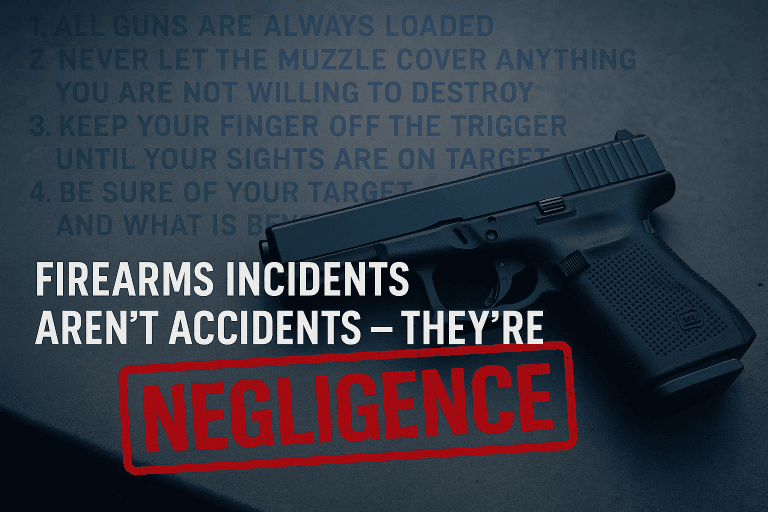
Safe gun handling comes before marksmanship. Shooters should understand and consistently follow established
fundamental gun safety rules
whenever they handle or use a firearm.
These aren’t beginner skills that we eventually leave behind.
They are the skills everything else is built upon.
Advanced handgun skills are primary handgun skills, mastered.
Once those skills become consistent, moving to a smaller handgun becomes much easier because the shooter isn’t trying to learn the handgun and learn how to shoot at the same time.
They’re adapting skills they already possess to different equipment.
Eventually, You Need to Train With the Gun You Carry
None of this means you should learn on a larger handgun and then carry a small pistol you’ve barely fired.
Quite the opposite.
If you’re going to carry a handgun for personal protection, you need to be able to operate that handgun reliably. You need to know how it recoils, how its trigger feels, whether you can manipulate its controls, and whether you can actually shoot it accurately.
The difference is that you don’t necessarily need to learn all of those fundamental skills on the most difficult handgun you own.
Learn the fundamentals first. Then apply them to the handgun you intend to carry.
Qualification Isn’t the Same as Proficiency
Passing a shooting qualification demonstrates that you met a particular standard on a particular day.
That’s useful, but it isn’t the same thing as developing solid handgun skills.
Someone can successfully complete a qualification while still having weaknesses in their grip, trigger control, gun handling or recoil management.
The opposite can happen too. A relatively inexperienced shooter struggling with a tiny lightweight handgun may decide they simply aren’t a good shooter when the equipment is making the learning process unnecessarily difficult.
A qualification measures performance. Training develops the skills behind that performance.
A Permit Class Can’t Fix Everything
This has become increasingly important in concealed carry training.
A permit class has a lot of material that must be covered. A renewal class has even less time available.
If someone arrives struggling to safely manipulate their handgun, without a consistent grip, anticipating recoil and having difficulty controlling the trigger, those problems cannot always be properly corrected during a permit or renewal class.
We can identify them. Corrections can be made. We can show the shooter what they need to work on.
But developing a reliable physical skill takes instruction followed by correct repetition.
Primary Handgun Skills
That’s one reason I separate Primary Handgun Skills from concealed carry permit training. The purpose is different. Primary Handgun Skills gives us the time to work on the fundamental skills necessary to safely operate and shoot a handgun before trying to build more advanced skills on top of them.
Before You Decide You’re a Bad Shooter
If you’re struggling with a small carry handgun, don’t immediately assume you can’t shoot.
Try a larger handgun.
Slow things down. Work on your grip. Work on your trigger control. Learn to operate the handgun without fighting it.
Build those skills with equipment that gives you a little more room for error.
Then go back to the smaller handgun.
You may discover that the problem wasn’t your ability to learn. You were simply trying to learn with equipment that demanded skills you hadn’t developed yet.
The Gun You Learn On Doesn’t Have to Be the Gun You Carry
Your concealed carry handgun should ultimately be a gun you can operate safely, reliably and accurately.
If you can’t shoot it well, its small size and easy concealment don’t make up for that.
But there is nothing wrong with developing your handgun skills on something easier to shoot and then transferring those skills to your carry gun.
In many cases, that’s a better way to learn.
Choose your carry gun because it meets your needs for carrying a handgun.
Choose your learning gun because it helps you develop the skills necessary to use one.
Those may eventually be the same handgun. They don’t have to be the same handgun on day one.