Before You Press the Trigger | HGWTC
What don’t you know yet?
Editor’s Note
The story that follows is fictional, but every decision point is based on situations that have occurred in real defensive encounters. While the characters are imagined, the lessons are real.
The purpose of this article is not simply to entertain. It is to help responsible armed citizens slow down, gather information, make sound decisions, and avoid actions that cannot be undone.
HGWTC Featured Story
Before You Press the Trigger…
An Ordinary Afternoon
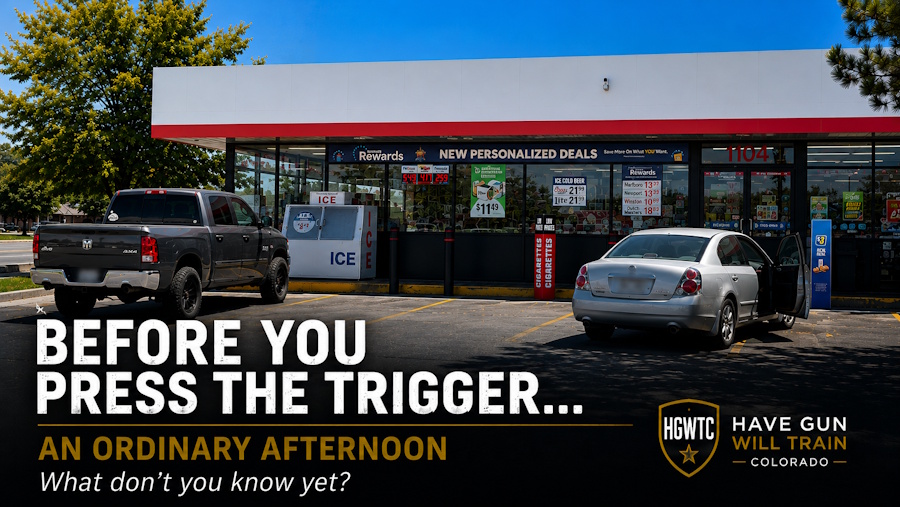
It was one of those hot Southern Colorado afternoons when the air shimmered above the pavement.
You pulled into the convenience store to top off the truck before heading home. Nothing about the stop seemed unusual. The gas pumps hummed quietly while traffic rolled by on the highway. A faint smell of gasoline mixed with warm asphalt, and every now and then the breeze carried the scent of wildfire smoke from somewhere in the mountains.
You glanced at the price sign.
“It’s gone up again.”
You shook your head, entered your rewards phone number, selected Regular, and started pumping gas.
Across the lot, people came and went from the store. A customer walked toward the entrance while another returned to a vehicle parked near the front. Cars passed on the highway without slowing.
Just another ordinary afternoon.
A man walked out carrying a cup of coffee. Someone climbed into a pickup parked near the ice machine.
Just another ordinary afternoon.
When the pump clicked off, you slipped the receipt into your pocket and walked toward the front door.
Cool air rushed out as you stepped inside.
The smell changed immediately.
Fresh coffee.
Roller grill food.
Fountain drinks.
The quiet hum of the beverage coolers.
The clerk looked up.
“Afternoon.”
You nodded and started toward the cooler to grab a bottle of water.
“Open the register.”
Not shouted.
Not screamed.
Just loud enough that every conversation stopped.
You froze.
A display rack blocked your view of the checkout counter.
You couldn’t see who was speaking.
You couldn’t see the clerk.
You couldn’t see anyone’s hands.
You heard movement.
Someone gasped.
Another customer slowly stepped backward.
For a split second, your mind tried to fill in the blanks.
Is this a robbery?
Who’s talking?
Does someone have a gun?
Where’s my family?
Should I move?
Should I draw?
You don’t know.
Not yet.
Understand the Legal Standard
Colorado law allows deadly physical force only under specific circumstances. Understanding what the law says—and what it does not say—is part of making sound decisions before a firearm is ever deployed.
And that is the point.
In many defensive shootings, the greatest danger is not poor marksmanship.
It is making a permanent decision before you understand what is actually happening.
Maybe the first person you see with a gun is the robber.
Maybe it is the store owner.
Maybe it is an armed citizen.
Maybe it is an off-duty police officer.
Maybe there is a second suspect you have not seen.
Or maybe the safest thing you can do is wait one more second and gather the information you do not yet have.
That one second may change everything.
Before You Press the Trigger
What don’t you know yet?
Learn From Real Encounters
At Have Gun Will Train Colorado, we encourage students to study real defensive encounters—not to copy what others did, but to understand how quickly circumstances change and why good judgment matters. Every incident reinforces the importance of gathering information, avoiding assumptions, and making legally and morally sound decisions.
One excellent educational resource is Active Self Protection, where John Correia analyzes actual defensive encounters and discusses the lessons armed citizens can learn from them.
Continue Your Training
Reading about defensive encounters is valuable, but developing sound judgment takes training and practice. These resources can help you build the legal knowledge, practical skills, and decision-making ability discussed in this article.
Colorado Concealed Carry Class
– Learn the legal, practical, and decision-making skills every armed citizen should understand.
Draw From the Holster
– Practice safely presenting your firearm only when deadly force is legally justified.
Firearms Training Schedule
– View upcoming classes and schedule your next training session.
Coming Next
In the next part, we will walk through this same scene step by step and examine hidden accomplices, mistaken identity, the importance of positive identification, armed citizens arriving late, and why a concealed carry permit does not make you law enforcement.
Talk first. Shoot last.
The gun is not a communication device.